01 Ongoing

Dwarf Galaxies — Observations & Simulations
TNG50 UVIT / GALEX Radiative transfer
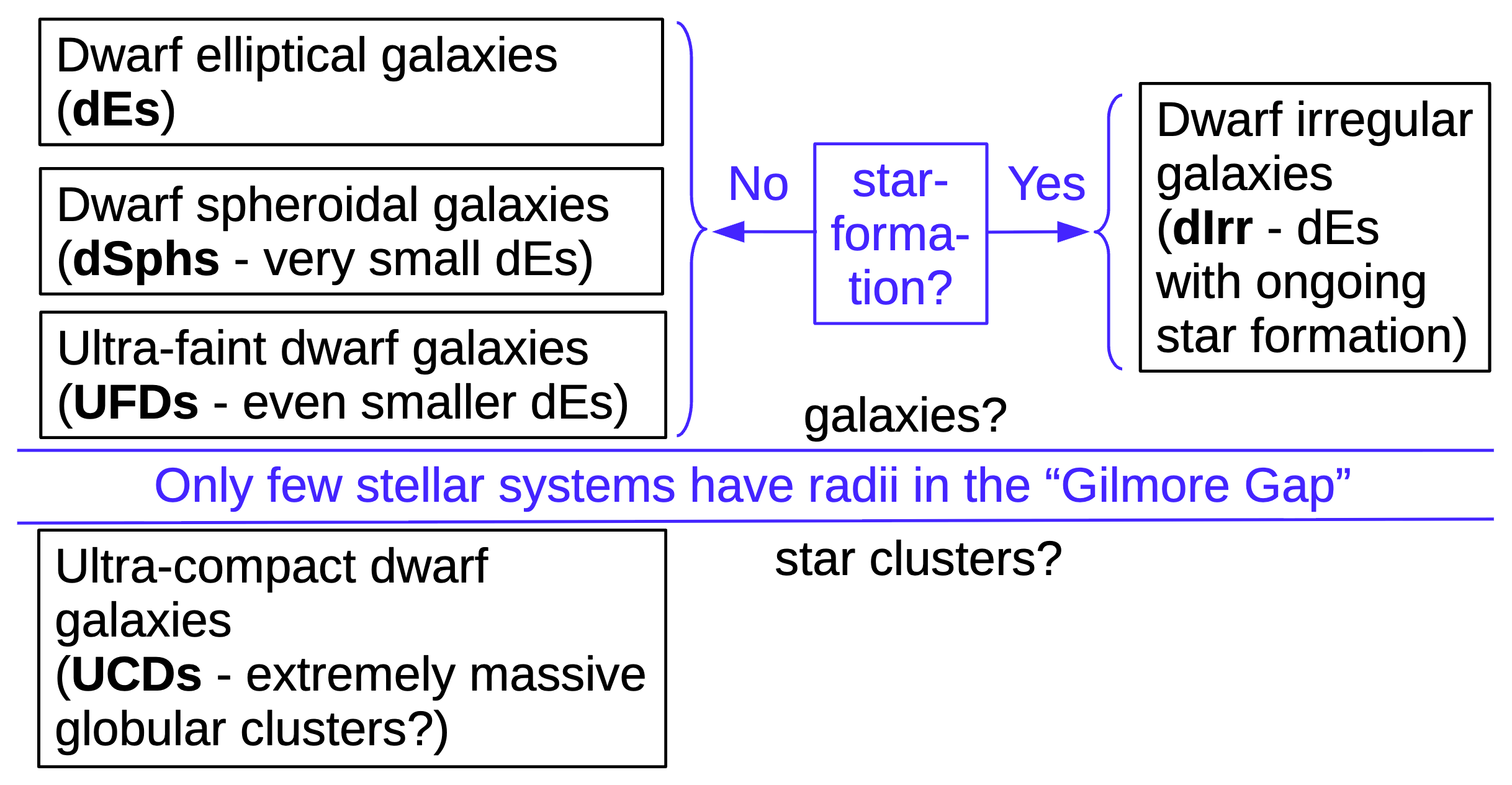
Classification of dwarf galaxy types
Dwarf galaxies are usually classified by whether they are still forming stars, with ultra-compact dwarfs bridging galaxies and star clusters.

Dwarf galaxies are the smallest and most numerous galaxies in the Universe, and they come in several distinct types: gas-poor dwarf ellipticals (dEs), the very small dwarf spheroidals (dSphs) and ultra-faint dwarfs (UFDs), and the gas rich dwarf irregulars (dIrrs) that are still forming stars, with ultra-compact dwarfs (UCDs) blurring the line between galaxies and massive star clusters.

Because they are low-mass and dark-matter dominated, dwarfs are regarded as near-primordial building blocks. In the ΛCDM cosmology, structure grows hierarchically: small halos form first and later merge to build larger galaxies, making dwarfs key tracers of this bottom-up formation history.
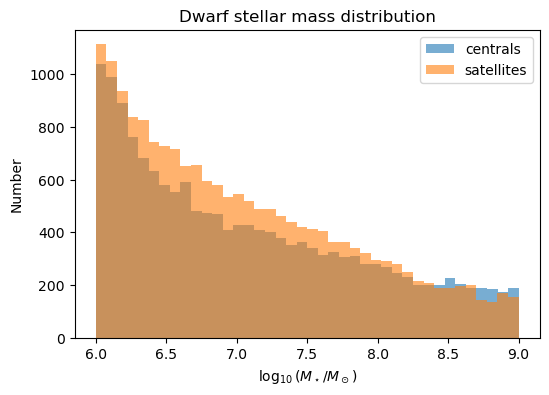
Stellar-mass distribution of the TNG50 dwarf catalogue
Stellar-mass distribution of the dwarf catalogue, split into centrals and satellites.
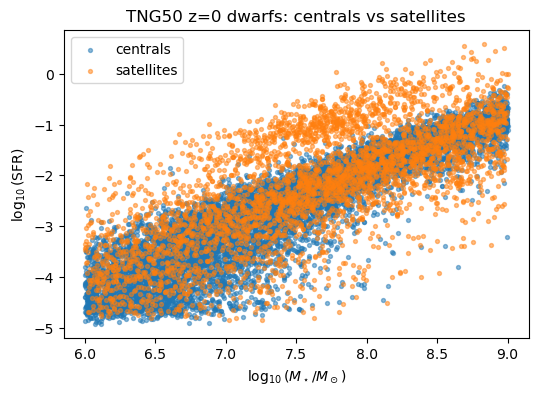
Star-formation rate versus stellar mass for z=0 dwarf galaxies in TNG50
Star-formation rate versus stellar mass for TNG50 dwarfs catalogue.

Working with the IllustrisTNG-50 simulation, I built a catalogue of z = 0 dwarf galaxies by applying stellar-mass cuts and ran a preliminary analysis, separating the sample into centrals and satellites. The plots above show the catalogue's stellar-mass distribution and its star-formation-rate–stellar-mass relation, where environment already leaves a clear imprint on dwarf star formation. To connect these simulations directly with data, I am now using the radiative-transfer code SKIRT9 to generate realistic mock images of the simulated dwarfs — synthetic observations that can be compared like-for-like against ultraviolet imaging of nearby galaxies, complementing studies of hierarchical star formation.
02 Ongoing

Interstellar Medium Filaments Analysis

Interstellar Medium Filaments Star formation
ISM filament detection result

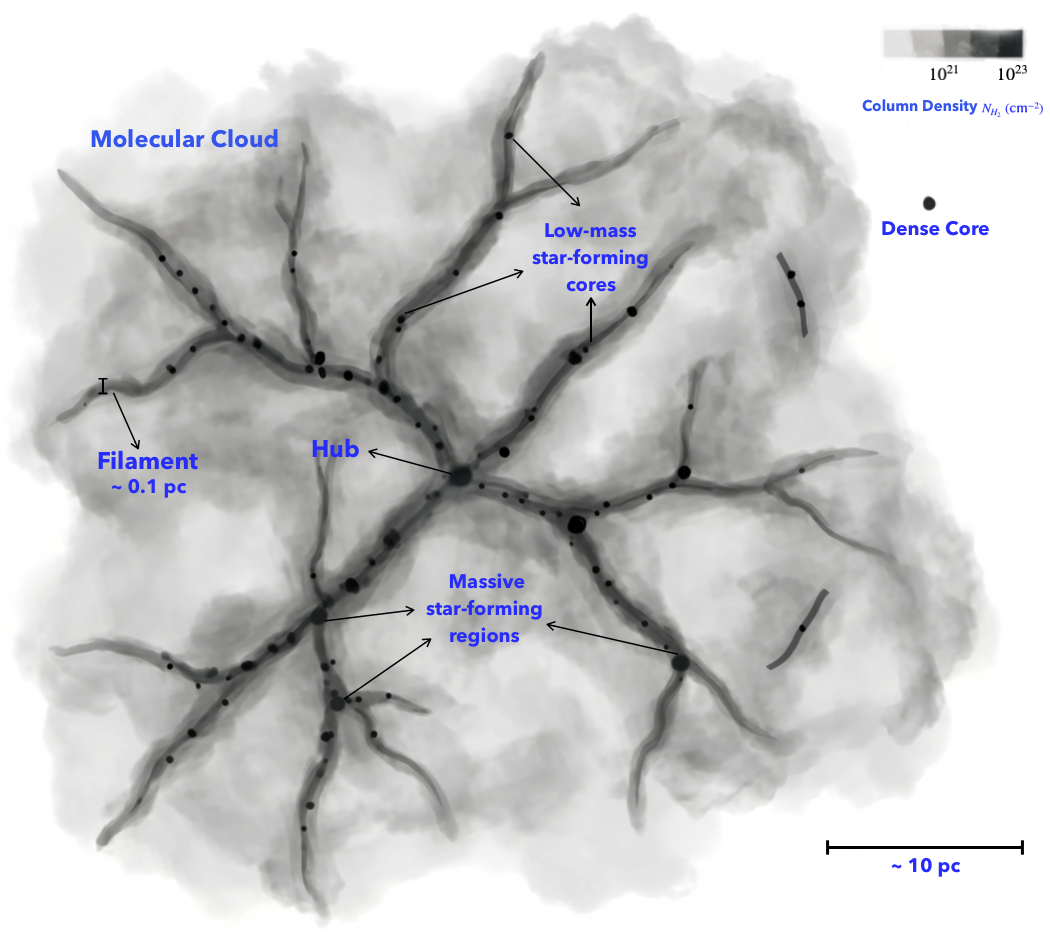
Interstellar filaments are long, dense structures in molecular clouds where cold gas is organised into network-like patterns. They are important because they are closely linked to star formation: dense cores often form along filaments, and high-mass stars are frequently found near filament junctions. Studying these structures helps us understand how molecular clouds evolve, how gas flows inside them, and how stars form from the interstellar medium.

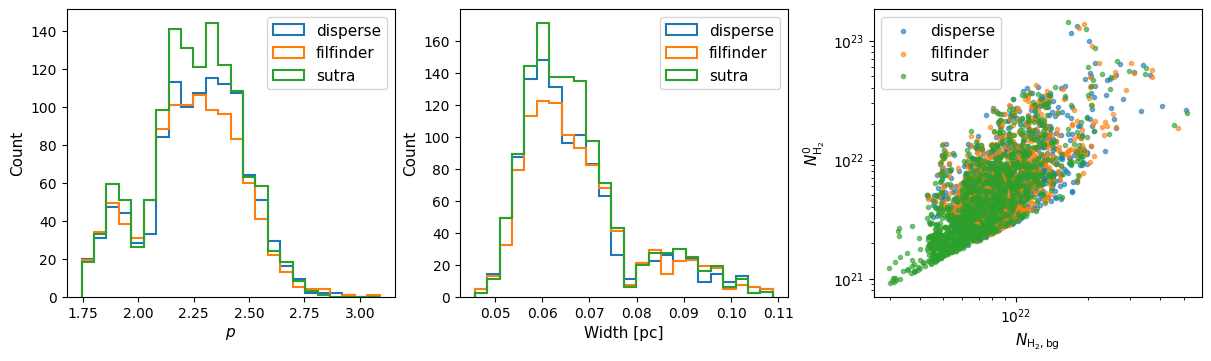
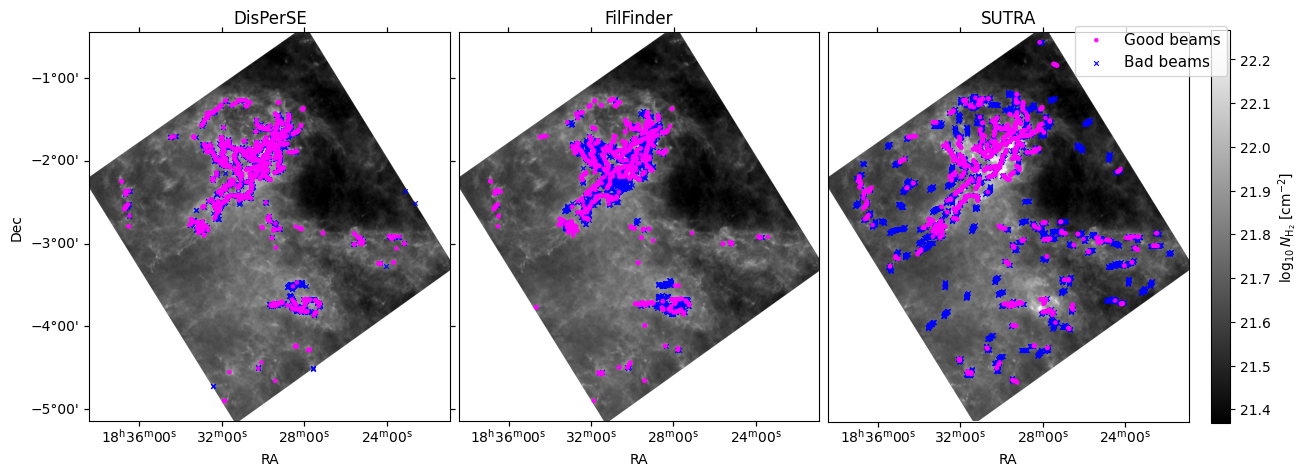
However, different filament-detection algorithms can produce different skeletons even for the same observation. This makes it important to check which detected structures are physically reliable before using them for science. Since real filaments are expected to show Plummer-like radial column-density profiles, we developed a systematic validation framework that samples radial profiles across each skeleton, fits them with a Plummer-like model, and classifies beam-sized filament segments as good or bad. This gives a quantitative way to compare skeletons from FilFinder, DisPerSE, and SUTRA, and to select reliable filamentary structures for further physical analysis.

Filament analysis plot
Comparison of filament skeletons from DisPerSE, FilFinder, and SUTRA with good and bad beam segments marked.
Filament analysis plot
Distributions of fitted filament properties for the three algorithms, showing broadly similar Plummer indices, widths, and background–filament column-density trends.
03

Score-Based Diffusion for Low-ℓ Primordial CMB B-Mode Reconstruction

CMB B Modes Stochastic Diffrential Equations Generative models
CMB B-mode recovery overview figure

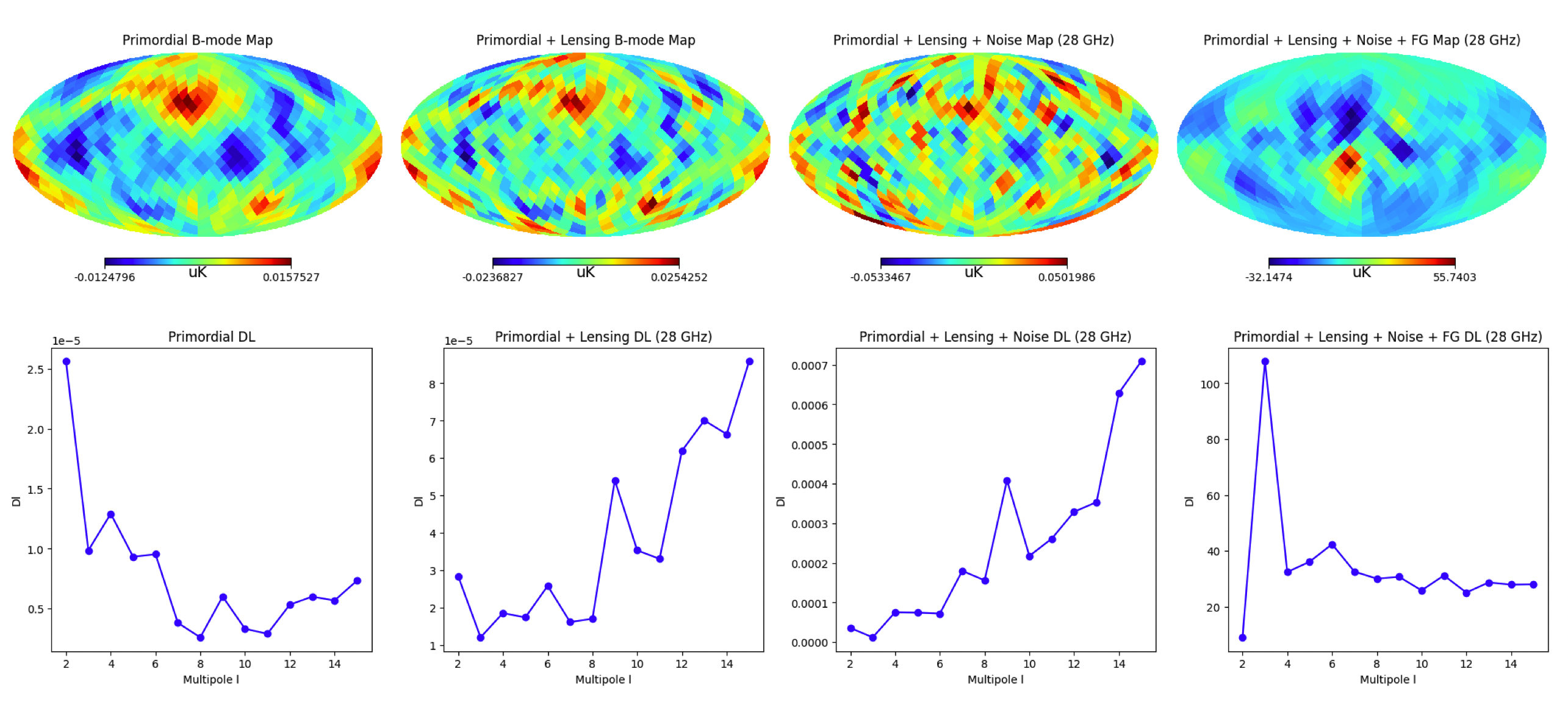
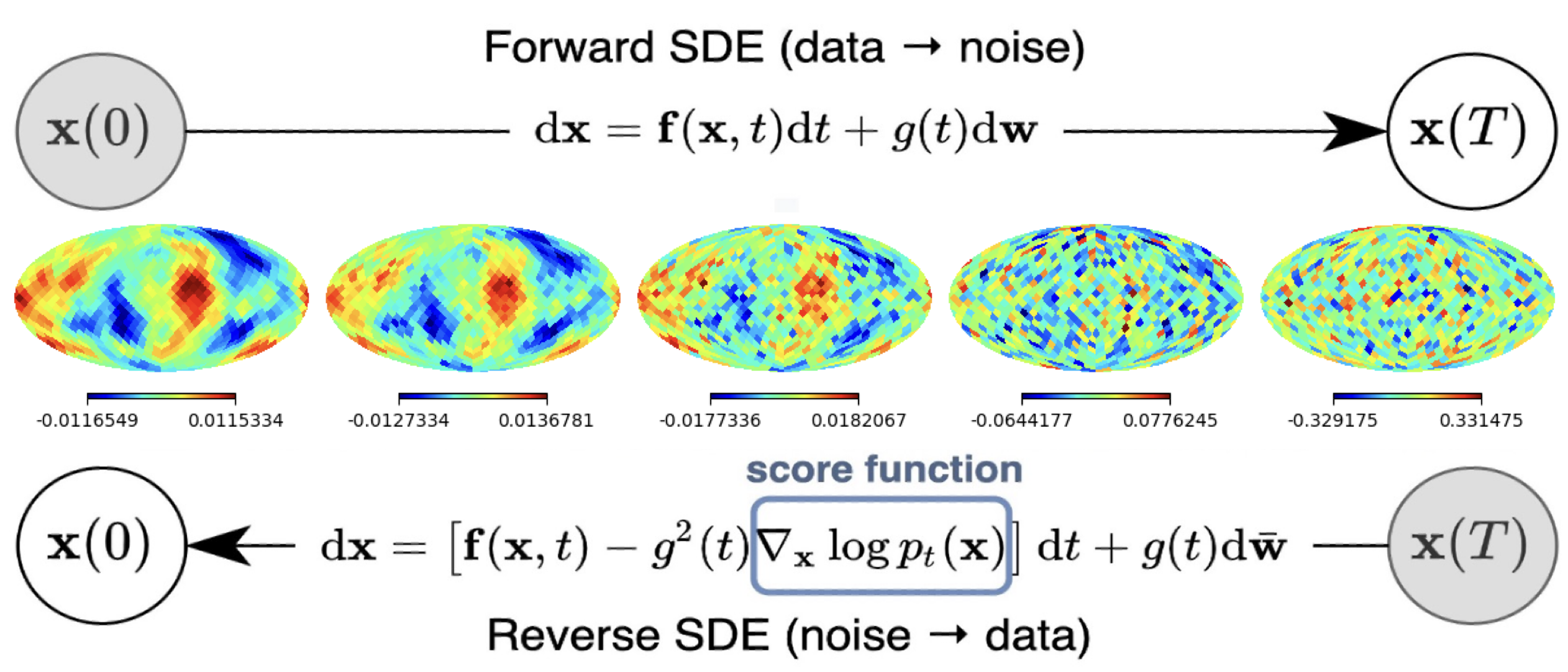
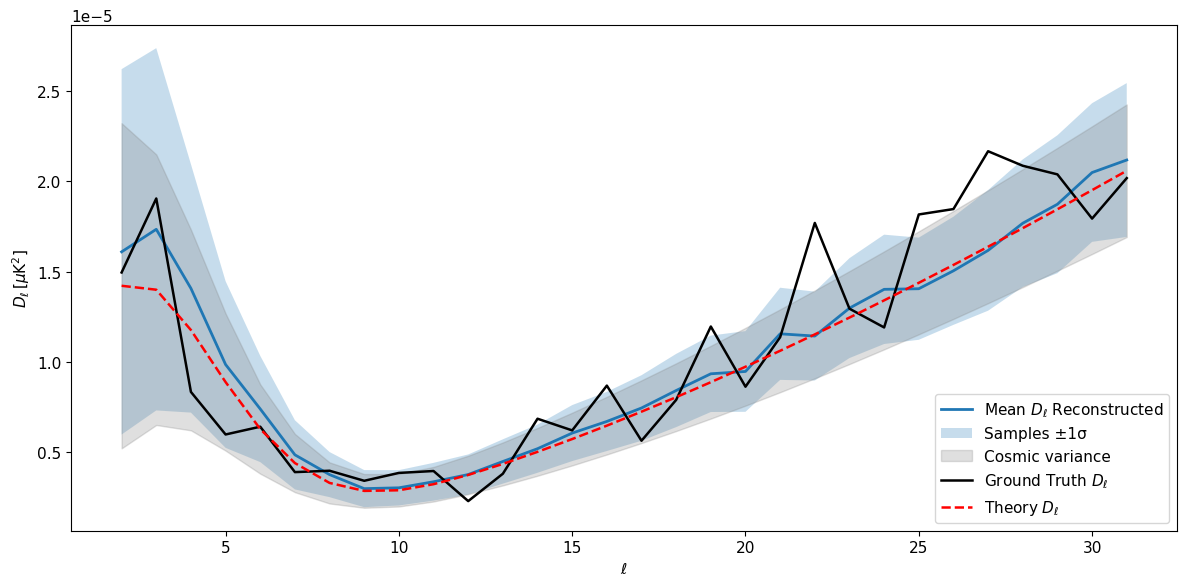
Detecting primordial B-mode polarization of the Cosmic Microwave Background (CMB) provides a direct probe of inflationary gravitational waves. However, the signal is extremely faint and contaminated by gravitational lensing, instrumental noise, and astrophysical foregrounds. Here we present a score-based diffusion approach, formulated using variance-exploding stochastic differential equations (VE-SDEs), to reconstruct the primordial B-mode angular power spectrum from contaminated observations.

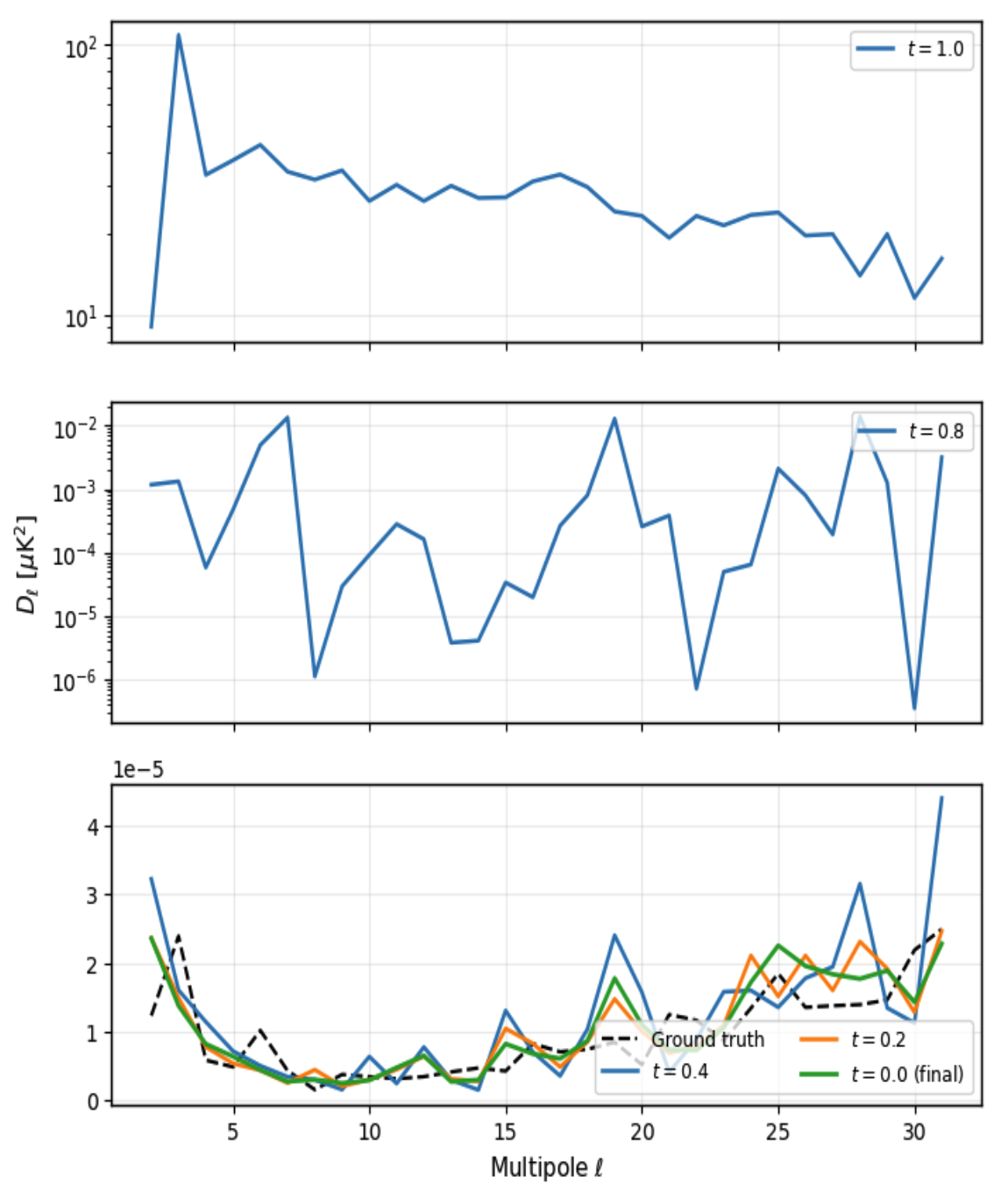
The method employs a reverse SDE guided by a score model trained exclusively on random realizations of the primordial low-ℓ B-mode angular power spectrum corresponding to a fixed tensor-to-scalar ratio r = 0.001. During inference, the reverse SDE iteratively drives the observed spectrum toward the learned primordial manifold, effectively denoising and delensing the input.

Score-based diffusion B-mode reconstruction figure
CMB B-mode result figure

The model is tested on simulated observations that include gravitational lensing, complex polarized foreground combinations, and instrumental noise characteristics representative of the proposed ECHO mission. The trained score model captures the underlying statistical distribution of the primordial B-mode field for the given r, acting as a physics-guided prior that can generate new, consistent realizations of the signal. This approach provides a robust framework for primordial signal recovery in future CMB polarization missions.

04

A Novel Sector-Based Algorithm for Star–Galaxy Classification

SDSS-DR18 Convolutional neural networks
Example SDSS stars and galaxies

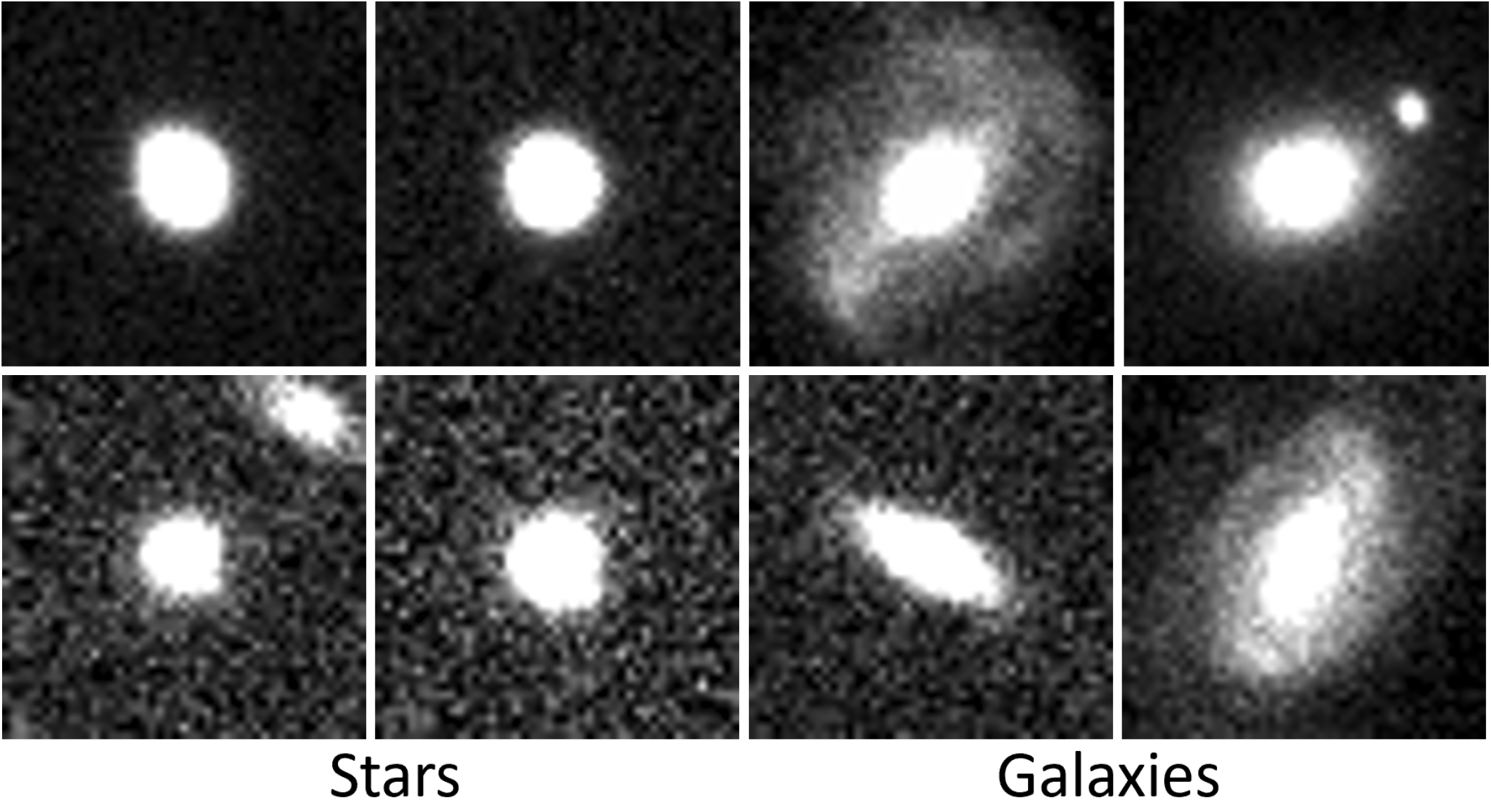
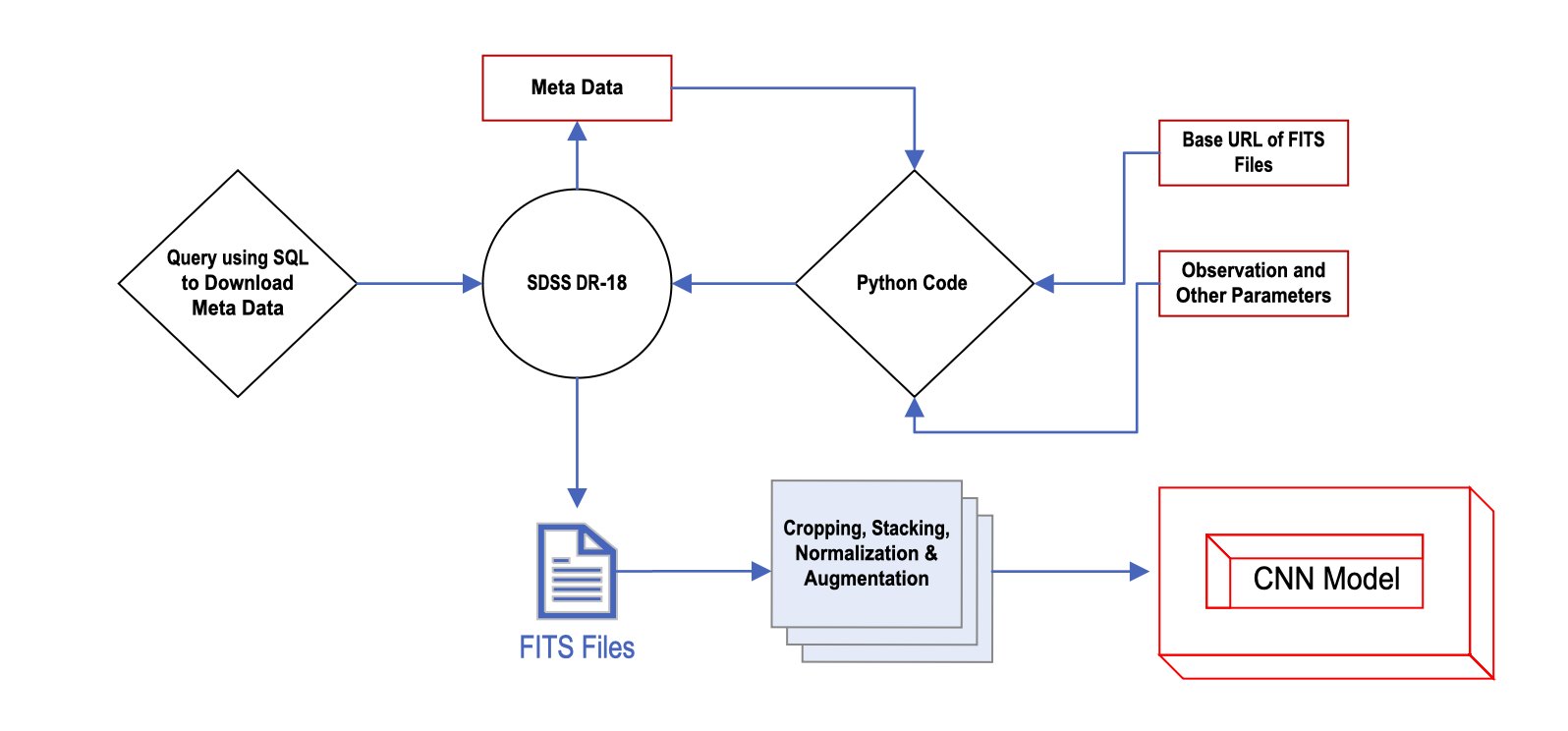
Modern sky surveys generate far more imaging data than astronomers can sort by hand, so reliably separating stars from galaxies has to be automated. In this work we introduce a sector-based approach using the latest Sloan Digital Sky Survey data (SDSS-DR18): instead of training a single model on a mixed sky distribution, we divide the sky into 36 sectors aligned with SDSS observation patterns — six 60° bins in right ascension and six 30° bins in declination — and train a dedicated convolutional neural network per sector.

Because each sector is more internally consistent, even a shallow three-layer CNN reaches state-of-the-art accuracy (around 95–96%), outperforming heavier baselines such as CovNet and MargNet while running far faster — about 25s per epoch on the combined data versus 180s and 1610s for those models. The method also generalises well to previously unseen sectors, staying robust where the comparison models degrade.

Star-galaxy classification data pipeline
End-to-end pipeline: an SQL query pulls SDSS-DR18 metadata, a Python script retrieves and crops the FITS images, and the stacked, normalized, augmented cutouts feed the CNN classifier.
05

Gauribidanur Radio Observatory LPDA Interferometric Array : SKA-Low Beamforming Testbed

Radio Interferometry SKA-Low CST simulations
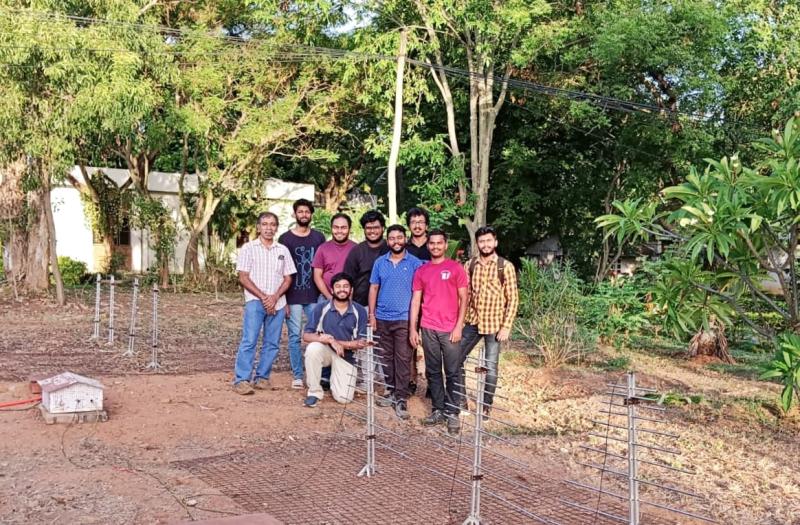
The two-element LPDA interferometric array at Gauribidanur Radio Observatory

As a Visiting Student at the Raman Research Institute, I worked on the broadband two-element radio interferometer at the Gauribidanur Radio Observatory (GRO) — a testbed for SKA-Low beamforming. The array uses eight log-periodic dipole antennas (LPDAs) arranged as two four-element groups along an east–west baseline, operating across 150–350 MHz to overlap the SKA-Low band.

My work spanned the full pipeline: simulating the LPDA antennas and phased-array geometry in CST to characterise the array's beam pattern and broadband response, commissioning the front-end electronics and verifying system stability, and observing solar and Galactic-plane transits.

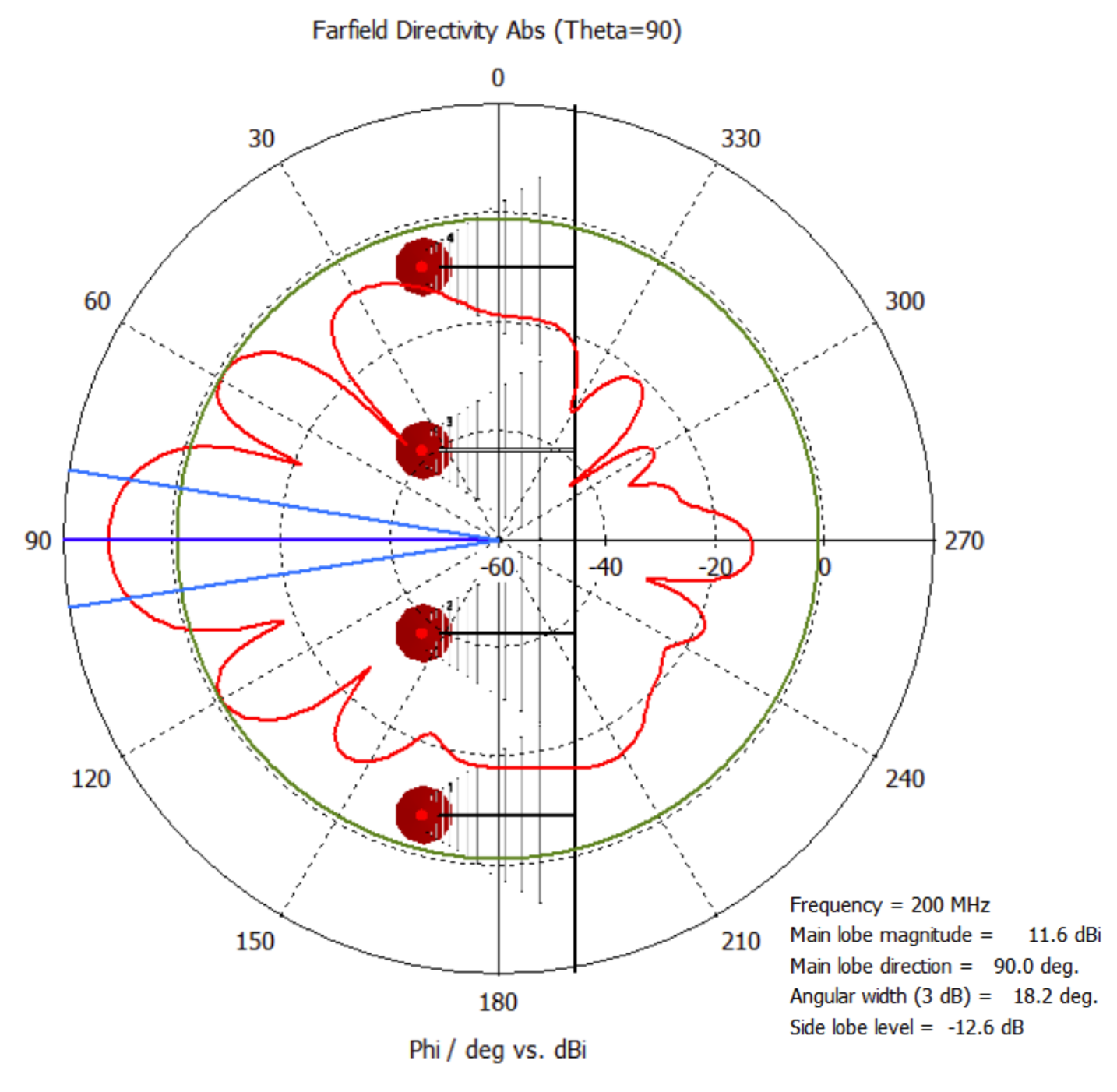
Simulated farfield directivity pattern of the array at 200 MHz
Simulated farfield directivity at 200 MHz: an 11.6 dBi main lobe with an 18.2° half-power beamwidth and −12.6 dB side lobes.
Live demo of GLOT — starting an observation, logging instrument settings, and post-processing the data.
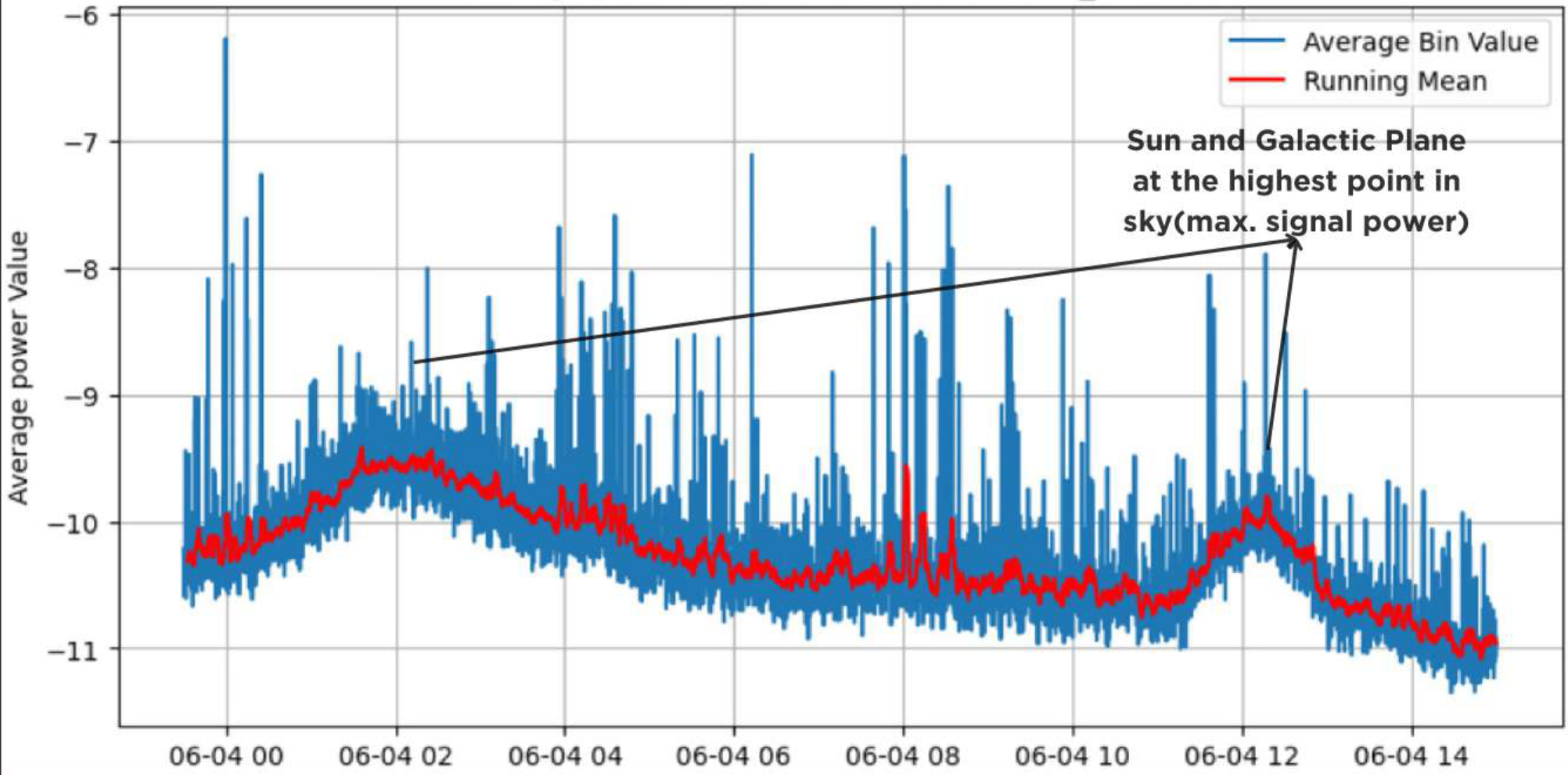
Sun and Galactic-plane transit captured with the interferometer
A transit observation captured through GLOT: the average power peaks as the Sun and the Galactic plane reach their highest point in the sky.

To operate the interferometer remotely, I developed GLOT, a Python web interface (Streamlit, PyVISA, and SCPI) that turns the observatory's data-acquisition system into a remotely accessible hub. Over a secure WLAN or VPN, users can start observations, log instrument settings, download data, and run post-observation analysis — including manual RFI masking, transit plotting, and fringe analysis. The system supports simultaneous multi-channel acquisition over long periods and was validated end-to-end with a successful solar-transit observation in June 2023.