Anumanchi Agastya Sai Ram Likhit
Astrophysics, N-body and Hydrodynamical simulations
I'm currently working as a Research Assistant at the Academia Sinica Institute of Astronomy and Astrophysics (ASIAA), where I study galaxy clusters as probes of cosmology. My broader research interests include galaxy formation and evolution across cosmic time, using multi-wavelength observations together with N-body and hydrodynamical simulations.
I am especially interested in how galaxy properties such as morphology, stellar populations, star formation, and the interstellar medium depend on environment, from isolated field galaxies to groups and clusters. More broadly, I am interested in how galaxies trace the underlying dark matter distribution, large-scale structure, and cosmology.
Outside of my core research, I care a lot about astronomy outreach and public awareness, getting people excited about the night sky is something I find really rewarding. I also like keeping a foot in other areas like data science, 3D modeling, and vision-related problems. And when I'm not doing any of that, you'll probably find me playing chess.
What do Galaxies tell us about the Universe?
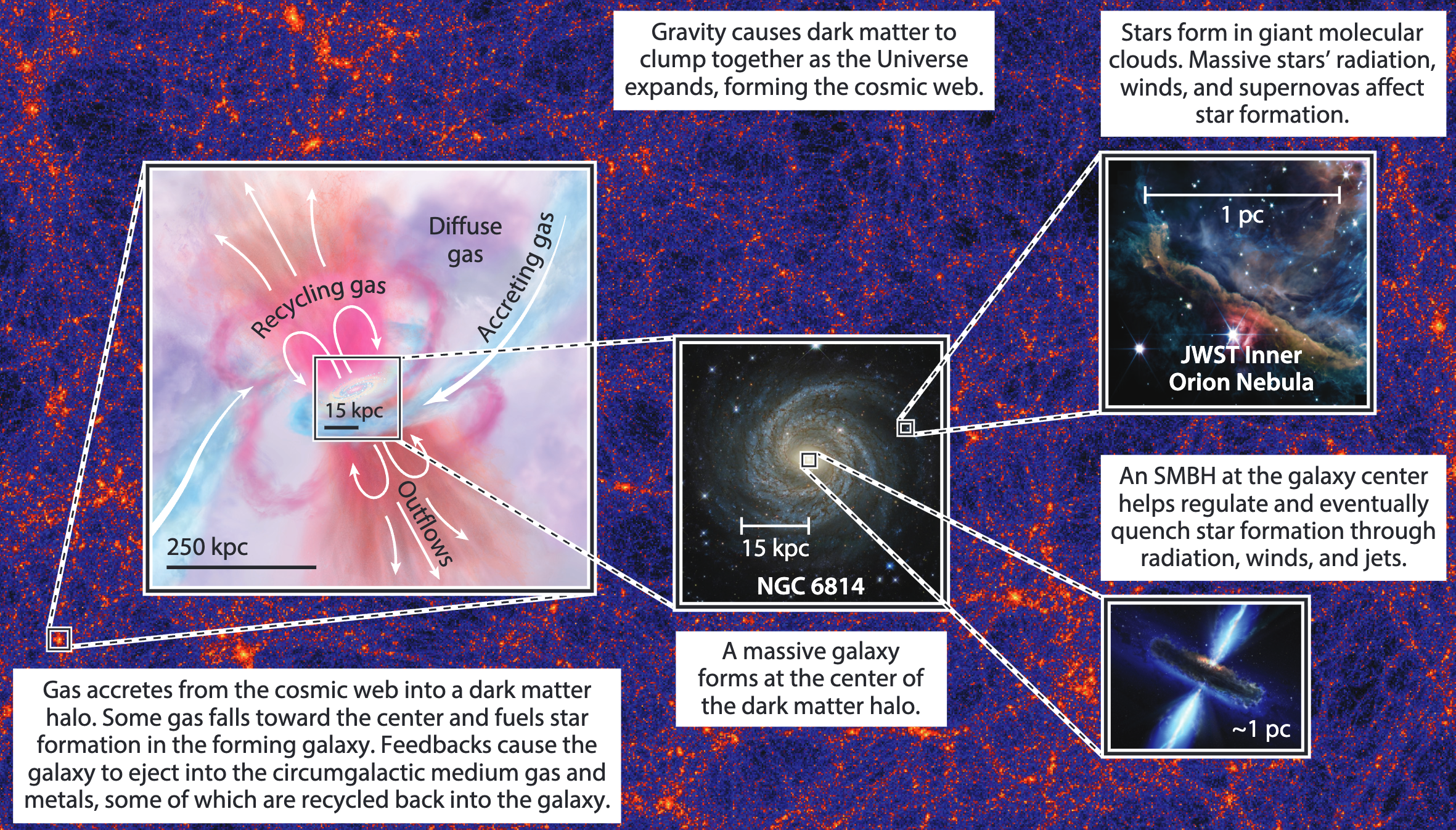
Galaxies are the sites where baryons cool, condense, and form stars within dark matter halos, which makes them the most accessible tracers of how structure assembled across cosmic time. Their observable properties like morphology, stellar populations, gas content, and kinematics record the integrated history of accretion, mergers, feedback, and environmental processing, so a galaxy's present state is effectively a fossil of its formation pathway.
What I find compelling is that this information is encoded across wavelengths and across scales at once. Multi-wavelength observations isolate distinct physical components, such as stellar ages, dust, cold and ionized gas, and AGN activity, while the clustering of galaxies links individual systems to their host halos and to the underlying matter distribution. This lets us treat galaxies simultaneously as astrophysical objects and as cosmological probes — and how galaxy properties depend on environment and halo structure is one of the questions I'm especially drawn to.
Can we build a Universe in a Computer?
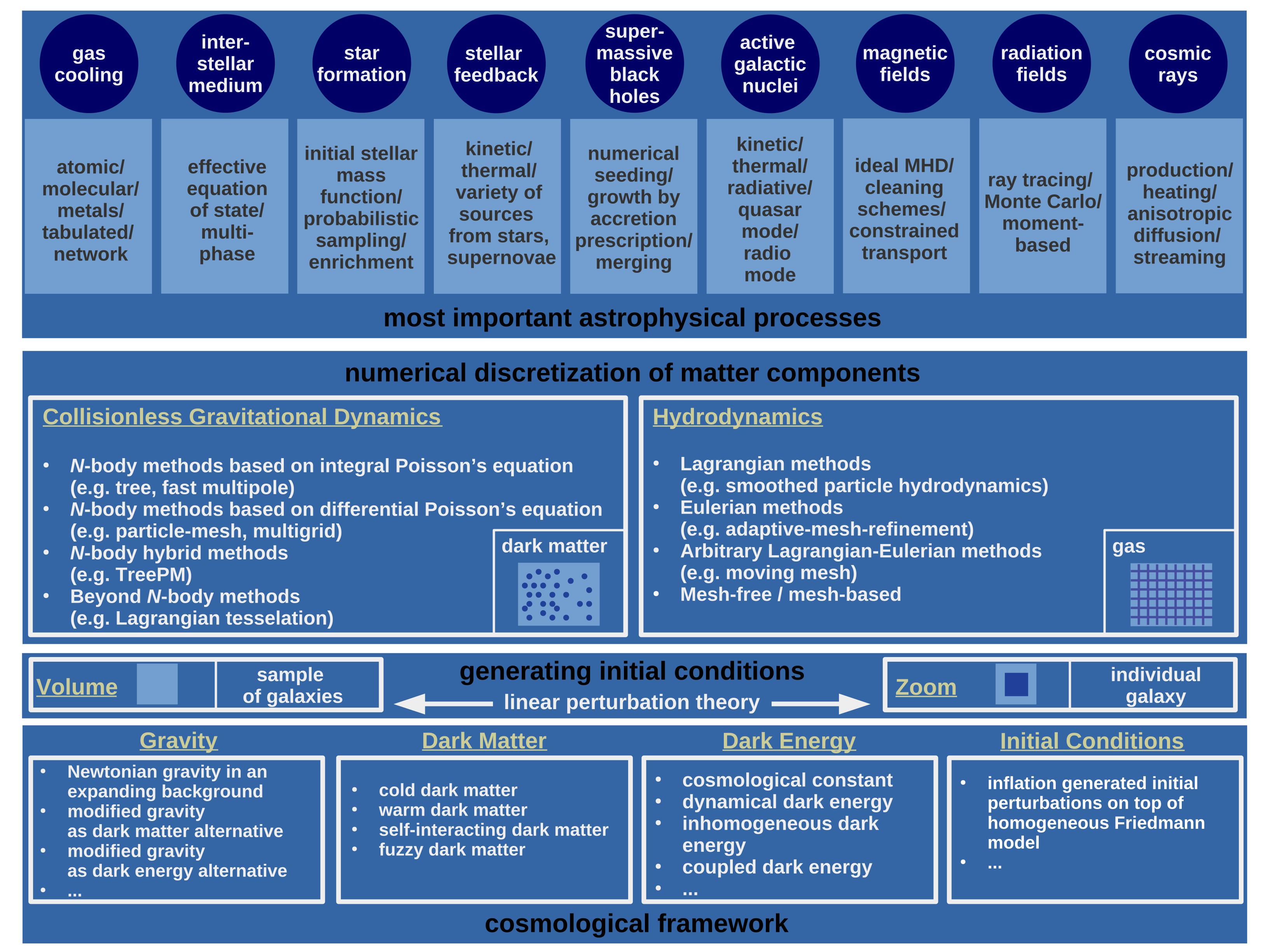
In a sense, yes — though not literally. We cannot recreate a galaxy or the Universe in a laboratory to conduct experiments, so the closest approach is to build a model universe within a computer. The idea is to utilise the physics we already trust: gravity acting on dark matter, hydrodynamics for gas, and a cosmological model grounded in observations. This information is encoded as equations, allowing us to evolve a small patch of the early Universe forward in time. Dark matter is tracked using N-body gravity solvers, while gas is evolved using hydrodynamics within the same gravitational field. Additionally, we incorporate smaller-scale astrophysical processes through sub-grid models, which include gas cooling, star formation, stellar feedback, black hole growth, and AGN feedback. The result is not the real Universe itself, but a self consistent universe that follows the same physical rules. How closely it resembles the observed Universe tells us how well we understand the underlying physics.
This is what makes simulations so useful alongside observations. A telescope shows us galaxies frozen at one moment, while a simulation gives us the full history and three-dimensional structure behind that snapshot — the accretion, mergers, and feedback that produced it. The two complement each other directly: we can turn simulated galaxies into mock observations, such as synthetic images, spectra, and SEDs, and analyze them exactly as we would real data, which lets us interpret what we see and test our assumptions at the same time. State-of-the-art projects like IllustrisTNG, EAGLE, SIMBA, and FIRE — built on codes such as AREPO, GADGET, and GIZMO — now reproduce realistic galaxy populations across cosmic time, ranging from large statistical volumes to high-resolution zoom-ins on individual galaxies.
"If the rate of expansion one second after the Big Bang had been smaller by even one part in a hundred thousand million million, it would have recollapsed before it reached its present size. On the other hand, if it had been greater by a part in a million, the universe would have expanded too rapidly for stars and planets to form."
Stephen W. Hawking